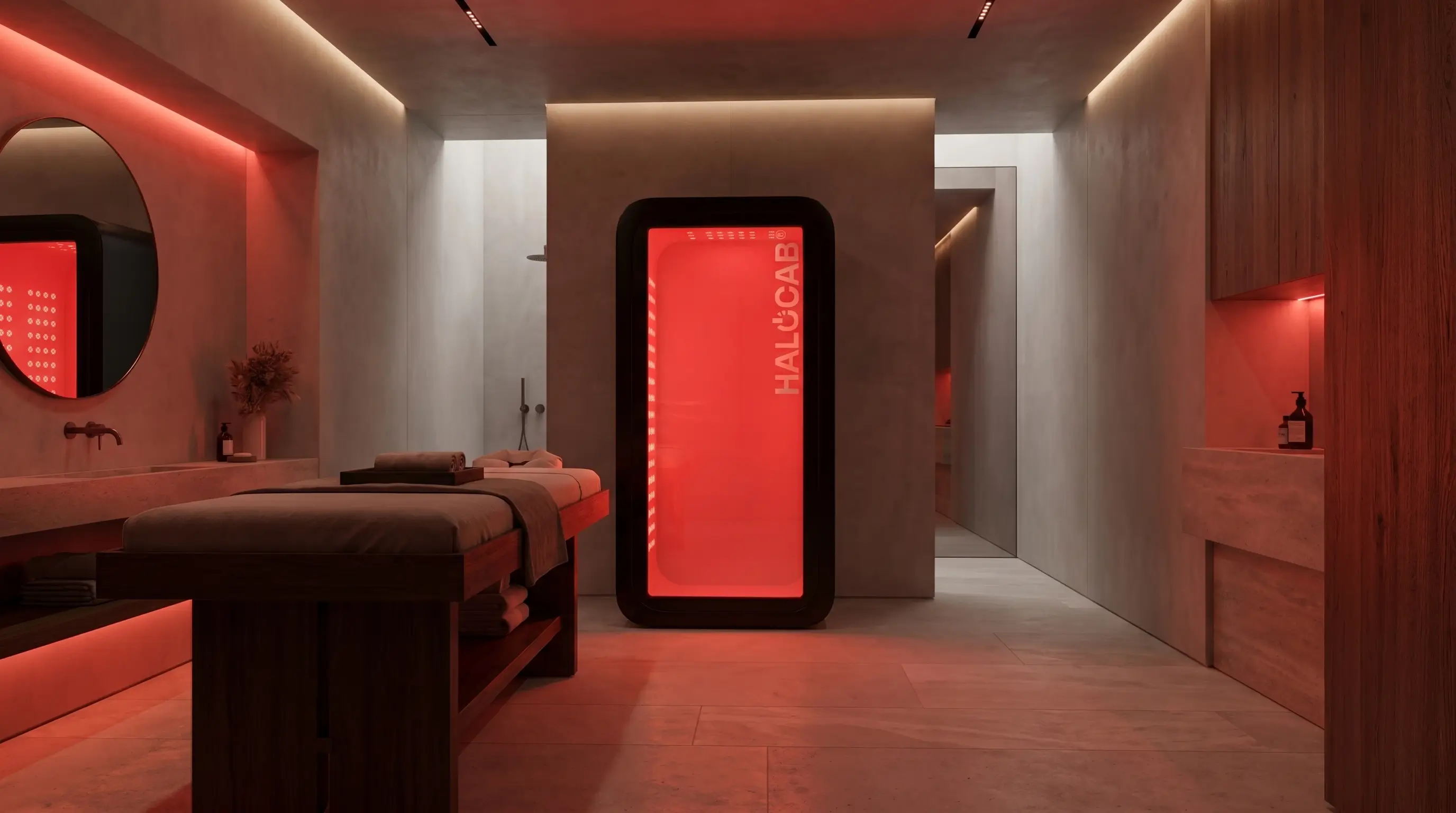
Red Light Therapy in the Spa: How Photobiomodulation Unlocks New Revenue Potential
The global wellness market reached a volume of 6.8 trillion US dollars in 2024. [1] The spa sector alone grew by 14.6 percent from 2023 to 2024, one of the strongest gains of any wellness industry. [1] The driver of this development is no longer classic relaxation, but longevity. At the centre of this trend stands a modality that is increasingly becoming a fixture in premium spas worldwide: photobiomodulation, better known as red light application.
This article shows how photobiomodulation can be deployed in spa operations. It describes the revenue potential and the criteria spa directors should keep in mind when making a selection.
Market data
Annual growth of selected wellness segments
Change 2023–2024
What is photobiomodulation?
Photobiomodulation (PBM) uses visible red and near-infrared light at wavelengths between 600 and 1,100 nm. [2] Unlike the infrared sauna, PBM does not work thermally. The user experiences no heat, but a calm, bright application. A session typically lasts 10 to 20 minutes and takes place sitting or lying down. In premium spas, PBM is positioned as a wellness and longevity application. It complements the classic portfolio with a calm, non-thermal modality. This combines well with other applications and creates a high-end experience.
Why spa operators are turning to photobiomodulation now
The Global Wellness Institute counts "traditional and complementary medicine" among the fastest-growing wellness segments. For this area, which according to the GWI also includes longevity and biohacking, annual growth of 10.8 percent is forecast through 2029. [1] Photobiomodulation therefore sits not at the edge of the market, but at its centre.
Three factors drive this development:
- Demographic change: by 2030, according to the WHO, one in six people worldwide will be 60 years or older. [3] This audience is actively looking for offerings that support vitality and wellbeing.
- Growing premium demand: guests whose travel is primarily motivated by wellness spend above average per stay. [1]
- Spa growth: the spa sector grew by 14.6 percent from 2023 to 2024, driven by premium concepts and longevity positioning. [1]
What revenue potential this opens up
From a business perspective, PBM has three characteristics that are particularly attractive to spa operators.
- High utilisation: a session lasts 10 to 20 minutes. Over a ten-hour day, this means 25 to 40 sessions per device are theoretically possible.
- Low staffing effort: unlike a massage, PBM does not tie up a therapist continuously. A briefing, programme selection and final check are enough.
- Add-on sales: PBM can be sold as a 15-minute module before or after classic treatments. This noticeably raises the average revenue per guest.
There is also a margin advantage. A multi-modality cabin justifies a significantly higher application price than a single-service device. We will return to this point in the section on selection.
How PBM fits into the spa concept
Photobiomodulation complements classic treatments without competing with them:
- Before a massage, as a calm warm-up that brings the guest into spa mode.
- After the sauna or cold chamber, as a closing module for a well-rounded wellness cycle.
- As a stand-alone offering for guests seeking a high-end experience in a short time.
- In day spa packages, as a high-margin module that lifts the package price.
- In longevity retreats, as a core application alongside breathing, mental and movement components.
What spa directors should look for when selecting
Not every red light device is suitable for professional spa operations. The following criteria are decisive:
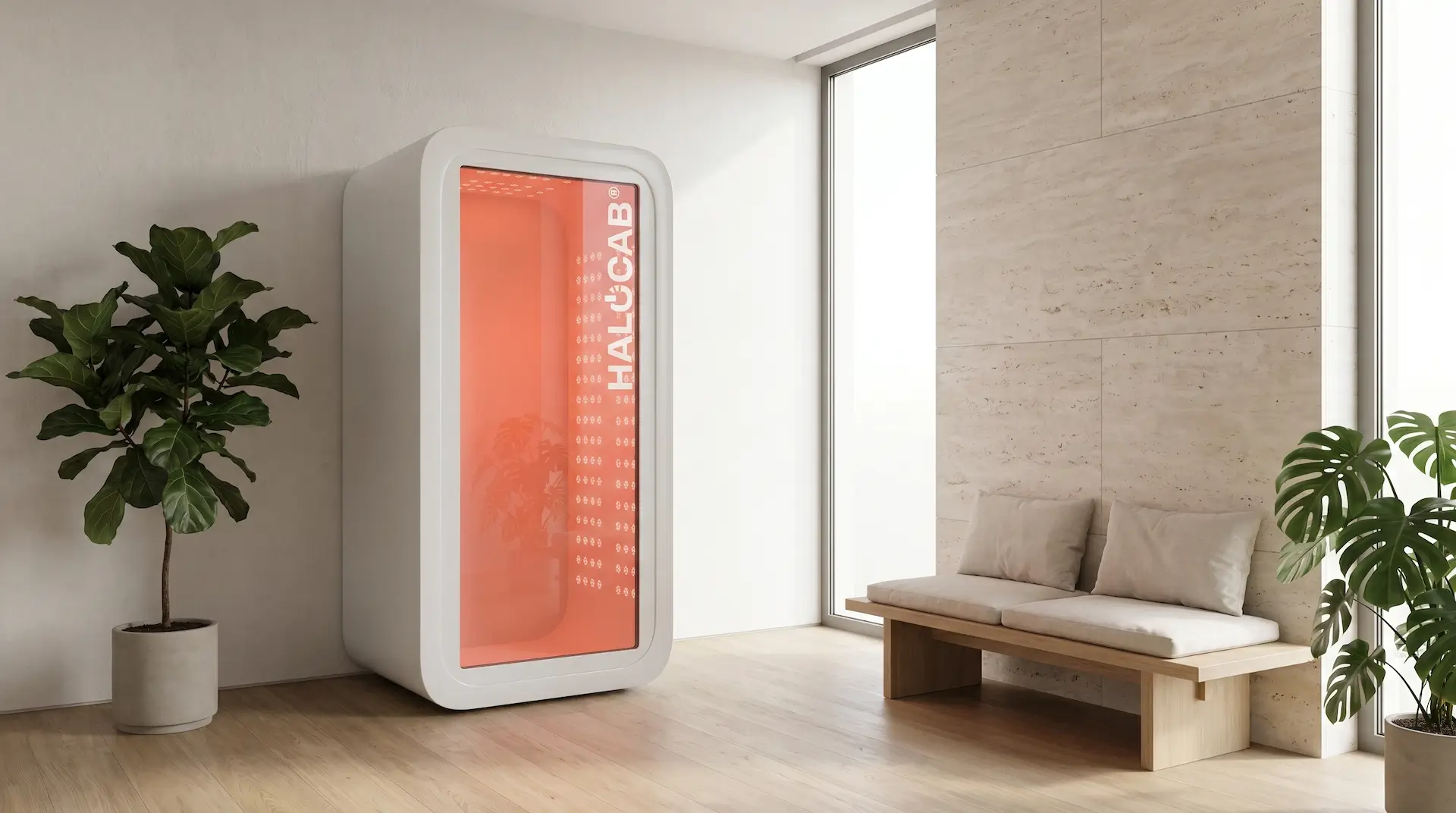
- Wavelength spectrum: high-quality systems cover not only red light (630/660 nm) and near-infrared (810/830/850 nm), but work across a broader range. HALOCAB additionally integrates blue light (480 nm), green light (525 nm) and extended near-infrared (940/1,060 nm) for different programme goals.
- Multi-modality: a pure red light bed offers one application. A longevity cabin combines several modalities in a single session and justifies higher prices. HALOCAB combines light with salt inhalation, ionised oxygen, frequencies and aroma, five pillars in one system.
- Software and personalisation: premium guests expect guided programmes rather than a simple timer. AI-supported personalisation is becoming a point of differentiation.
- Space requirements and installation: a stand-alone cabin needs around 2 m² of floor space and a standard power connection, considerably less than a salt grotto or floating installation.
- Origin and service: "Made in Germany" is more than a marketing promise in the premium segment. Robust components, documented wavelengths and accessible service. Many low-cost red light loungers come from Asian manufacturing, where maintenance and spare-parts supply are more demanding.
Photobiomodulation as part of a longevity concept
The strongest positioning emerges when PBM is integrated not in isolation, but as a building block of a longevity concept. A combination of a PBM cabin, whole-body cryotherapy and breathing or mental training creates a modular offering. It can be scaled across all price tiers, from the day spa ticket to the multi-day retreat.
Hotels with such an offering position themselves clearly in the growing longevity segment. In doing so, they appeal to a clientele that, according to the Global Wellness Institute, ranks among the most profitable hotel guests. [1]
Conclusion
Photobiomodulation is not a fad, but an established modality with growing market maturity in the premium spa segment. For spa directors who want to future-proof their offering, the question is not whether red light belongs in the portfolio, but in what quality and form. Those who opt for multi-modality, documented wavelengths and "Made in Germany" strengthen utilisation, margins and brand value at the same time.
Sources
- Global Wellness Institute: Global Wellness Economy Monitor 2025 (November 2025). https://globalwellnessinstitute.org/industry-research/2025-global-wellness-economy-monitor/
- Barolet D.: Light-Emitting Diodes (LEDs) in Dermatology. Seminars in Cutaneous Medicine and Surgery, 2008;27(4):227–238.
- World Health Organization: Ageing and health (Fact sheet). https://www.who.int/news-room/fact-sheets/detail/ageing-and-health